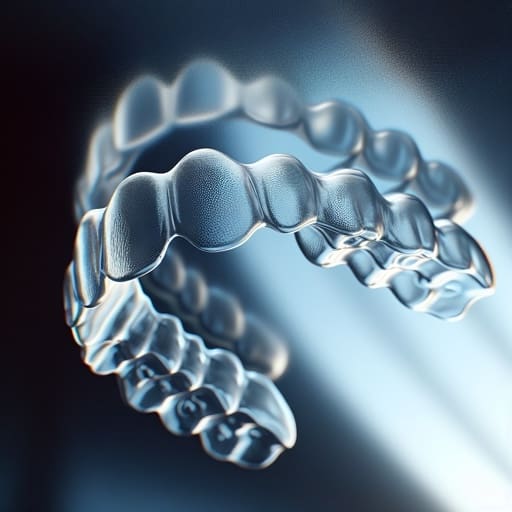
An occasionally irregular blog about orthodontics There is a growing use of clear aligners in the mixed dentition to correct developing malocclusions. One of these is an anterior crossbite with a forward displacement on closure. I have previously discussed this treatment in a study comparing Clear Aligners with a Z-spring appliance. This study is similar in that it compares clear appliances with a removable inclined plane. It offers more valuable insights into the effectiveness of clear aligner treatment.
A team from Mansoura, Egypt conducted this research. The angle orthodontist published the paper.
What did they ask?
The authors did this study to
“Evaluate the dental-facial changes and the improvement in oral health-related quality of life between clear aligners and inclined plane appliances for managing anterior functional crossbite in the mixed dentition.”
What did they do?
They conducted a single-centre, randomised clinical trial with a parallel design, allocating participants in a 1:1 ratio. The PICO was:
Participants
24 children aged 8 to 12 years who had an anterior functional crossbite involving more than two teeth
Intervention one.
In-house clear aligners. They asked the patients to wear their aligners for 22 hours a day and change the aligner every 10 days.
Intervention 2.
A removable inclined plane which fitted the lower arch. This was made of transparent sulfur-cured acrylic resin, which was applied to a PETG sheet. The operator saw the patients every two weeks, and the operator relieved the inclined plane. After the completed treatment, they asked the patients to wear their appliance for a further four weeks.
Outcomes
The primary outcomes were cephalometric measurements; however, they based their standard sample size calculation on the upper incisor to SN angle, and I’ve assumed that this is the primary outcome. Secondary outcomes were oral health-related quality of life, and they measured this using the CPQ 8-10 questionnaire.
The team performed a clear sample size calculation that suggested they needed 12 patients per group.
The same postgraduate student treated all the patients at a single centre.
They used a pre-prepared randomisation sequence, and the allocation was performed by drawing a card from a box containing 24 cards, with 12 cards assigned to each group. It was not possible to treat the patients blindly; however, all data was analysed blind.
They analysed the data using univariate statistics to evaluate any differences between the groups.
What did they find?
24 of the patients completed the trial. I could not find any information about whether they corrected all the crossbites, but I assume that this was the case.
At the start of treatment, there were no differences between the two groups.
They then supplied a large amount of cephalometric data with multiple comparisons. As you know, I find this kind of data presentation rather confusing and unclear. This is especially due to the risk of false positives when measuring many related variables and performing simple statistical tests.
As a result, I have just concentrated on the straightforward outcomes of upper incisor and lower incisor angulation.
When they looked at U1-SN. In the clear aligner group, after treatment, the upper incisor position was 114.44mm (6.03). Whereas for the inclined plane appliance, this was 108.1 mm (4.31). The mean change in this measurement was 11.65mm (3.95) for the clear aligner and 6.73mm (2.94) for the inclined plane group. This difference was statistically significant.
When they evaluated the L1-NB (mm). For the clear aligner group, the mean was 4.01mm (1.73), and for the inclined plane group, it was 3.93mm (2.34). When they evaluated the change in this measurement, this was 0.77mm (1.42) for the clear aligner and -2.03mm (2.21) for the inclined plane group. This was statistically significant.
Finally, there were no differences in the oral health-related quality of life measurement between the groups; however, both groups showed an increase in this measurement, indicating an improvement in oral health-related quality of life for all participants.
The final conclusions were;
“The clear aligner group experienced more proclination of the upper incisors, whereas the inclined plane group showed that upper incisor proclination and lower incisor retrusion resulted in the correction of the anterior crossbite”.
What did I think?
Firstly, I thought it was positive to see more studies exploring the effectiveness of clear aligners. Importantly, this study demonstrated that clear aligners are an effective treatment for anterior cross-bite with a functional shift. However, it was also notable that there were no significant differences in the final treatment outcomes between the clear aligners and the simpler inclined plane appliance. This finding is important because, as the authors suggested, the inclined plane appliance offers a cheaper alternative to using clear aligners.
When I examined the design of the two interventions before reading this paper, I expected to see different cooperation rates, as the inclined plane seems to be a much more challenging device for participants to tolerate. It was interesting that this was not the case, as there were no significant differences in cooperation rates between participants in either group.
In summary, this was another well-conducted small study on the effectiveness of clear aligners. This leads us to the conclusion that this study provides important information that may guide our patients’ decisions when they are giving consent for treatment. The post Can clear aligners correct crossbites in the mixed dentition? appeared first on Kevin O'Brien's Orthodontic Blog.
Content mobilized by FeedBlitz RSS Services, the premium FeedBurner alternative. |