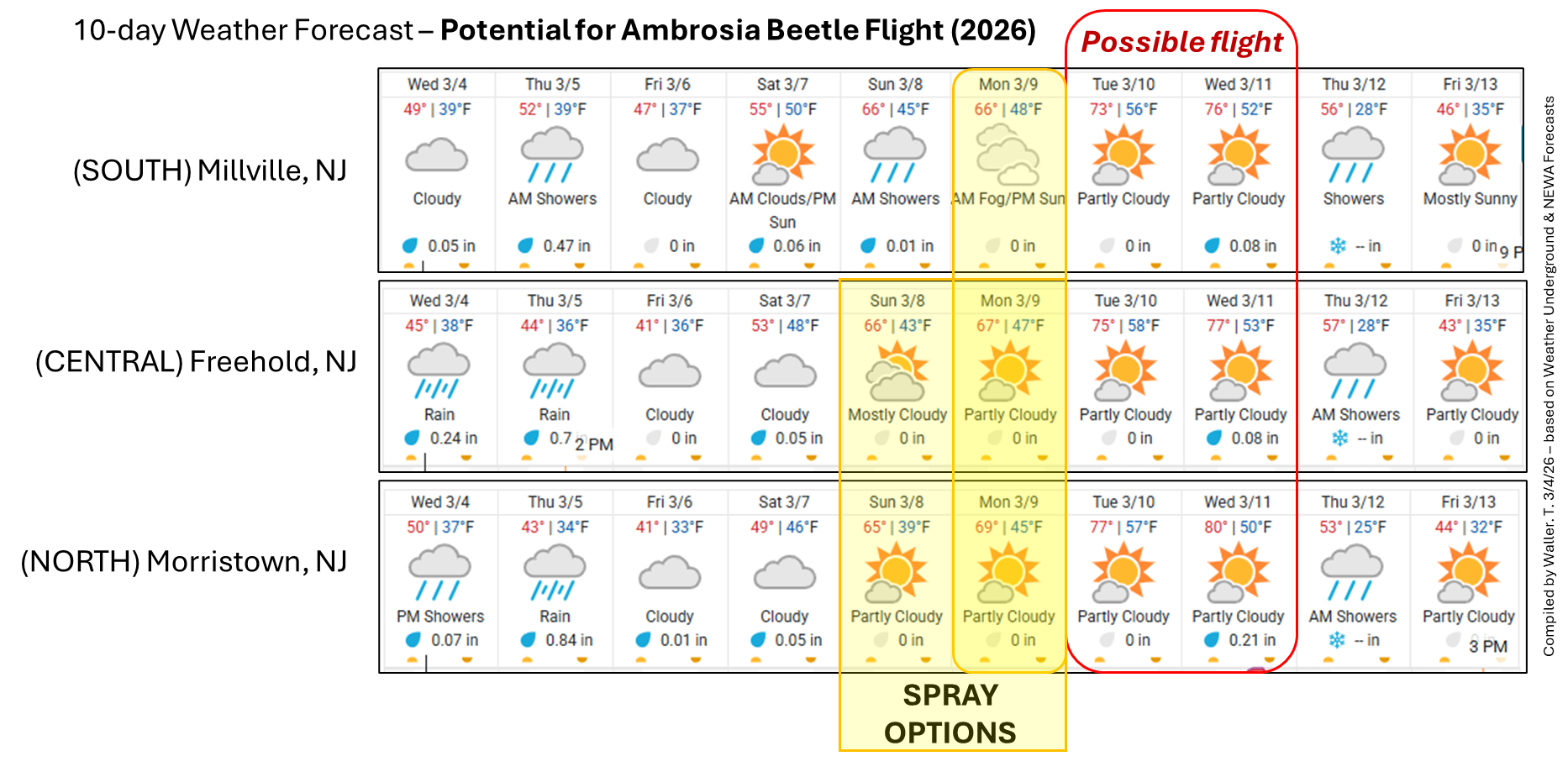
 Rutgers Cooperative Extension The last few seasons we have seen an upswing in ambrosia beetle activity in nursery production, principally in field grown nursery stock of thin barked trees (commonly – dogwood, honey locust, magnolia, maple, redbud, zelkova, styrax, Prunus spp.). Based on evidence from multiple lines of trap collection data throughout the United States, adult female flights appear to be correlated to consecutive days (2-3) of 70F temperatures (highs) with daily average air temps around 65F (max+min/2). That is extremely close to what we will have throughout most areas of NJ early next week, based on 10-day weather forecasts. Note: this is historically very early for treatment of this pest and it will get colder the following days, however, we have missed control opportunities over multiple years so take treatment into consideration if you regularly encounter this pest.
Consider using pyrethroids in your production areas next Monday or Tuesday (weather dependent) if this pest has been a regular problem.
Contact insecticides:
- Pyrethroids [3A]: –thrins (bifenthrin, permethrin, etc.) – Pyrethroids longer lasting residual activity is why these materials are so effective against ambrosia beetles.
- Systemic insecticides DO NOT WORK
Stay informed:
- Sign up for the 2026 – Rutgers Ornamental IPM Program – click here to sign up
- First webinar 4/14/26
- Program is free, but registration is required – Registration includes:
- Site visit to your ornamental nursery/farm from Rutgers agents
- Delivered printed IPM resources (Guides, factsheets, bulletins)
- Free pheromone & sticky trap kit + guidance on setup/monitoring (for commercial nursery/greenhouse and Christmas tree farms)
- Access to live bi-weekly webinars (Zoom)
- (First session TUESDAY 4/14 @ 12PM)
- Every Second and Fourth, Tuesday, April through September
about – Ambrosia Beetles (Xylosandrus spp.)
Host plants: Hundreds of deciduous, thin-barked species, commonly – dogwood, honey locust, Magnolia, maple, redbud, Zelkova, Styrax, Prunus spp.
Overview:
- New Jersey notable species in ornamentals: Black stem borer (Xylosandrus germanus) and Granulate borer (Xylosandrus crassiusculus)
- As of 2025, the invasive Redbay Ambrosia beetle (Xyleborus glabratus) is currently in the southern USA, but moving north
- Number of generations is subject to debate, often 1-2
- Very small, reddish brown to black, cylindrical beetles (2-2.5 mm), entrance/exit holes ~ 1 mm in diameter
- Adults overwinter, mate, and lay eggs in sapwood galleries (tunnel system)
- Ambrosia beetles create these galleries to grow ‘ambrosia’ fungi, as their sole food source which are transported to new hosts by adults in a specialized structure known as a mycangia
- Are attracted to and infest stressed plants that are releasing ethanol
- Infestations increase plants’ risk for infection by opportunistic pathogens
- Symptoms include sawdust and frass ‘toothpicks’, increased sap production, branch wilting, dieback, bark cracking, and wood staining
Cultural Practices:
- Avoid transporting infested plants
- Reduce plant stress; particularly water-related stressors such as waterlogged roots (an anaerobic condition) which are more likely to produce ethanol and be attacked
- Closely monitor new plantings, especially if planted during adverse climatic periods such as excessive rain, drought, or intense heat
- Monitor ethanol baited traps (soda bottle traps, Lindren funnel traps, black panel traps, ethanol-soaked wood bolts) at wood line and within production area
Materials:
Contact insecticides:
- Pyrethroids [3A]: –thrins
Systemic insecticides:
- None- these beetles feed on ambrosia fungi in galleries, not plant tissue
Biorationals:
- Limited efficacy: entomopathogenic – fungi Beauveria bassiana, Metarhizium spp.
- Research focused on antagonistic fungi, endophytes, ambrosia fungi management and plant defense activators is promising
Critical Target Windows and Pesticide Use Considerations
- Once ‘toothpicks’ are observed on a host plant, it is too late to use contact pesticides on that plant
- Monitor early spring weather forecasts – evidence that adult flight often occurs after successive (2-3 days) of temperatures above 70ºF
- Redbud bloom is a useful plant phenology indicator (PPI)
- Use contact insecticides with caution as they can harm beneficial insects
PESTICIDE USE DISCLAIMER. THE LABEL IS THE LAW . The Rutgers Plant and Pest Advisory is not intended for homeowners. Recommendations and considerations given herein are designed to be specific to the state of New Jersey, even though it may be broadly applicable across multiple geographic areas. A pesticide applicator is legally bound by the labeling found on and with the pesticide container in their possession. Before using a pesticide, check and always follow the labeling distributed with the product at the point of sale for legally enforceable rates and restrictions. New Jersey notes. 1. Private and commercial applicators must be certified AND possess a valid applicator license to make applications or supervise the use of ANY* EPA-registered pesticide (*as required NJAC 7:30; limited exemptions exist). 2. Only certified applicators possessing a valid New Jersey applicator license may purchase restricted use pesticides (RUPs). 3. Pursuant to NJ S1016, neonicotinoids can only be applied in agricultural settings. Commercial applications in outdoor, non-agricultural settings (i.e. landscapes) is prohibited, with no pest-specific exceptions, as of the printing of this document. In addition to the pesticide chemistries and Mode of Action (MoA) listed in this document, others may be commercially available. It is understood that no discrimination is intended and no endorsement by Rutgers Cooperative Extension is implied. THE LABEL IS THE LAW. Cooperating Agencies: Rutgers, The State University of New Jersey, U.S. Department of Agriculture, and Boards of County Commissioners, Rutgers Cooperative Extension, a unit of the Rutgers New Jersey Agricultural Experiment Station, is an equal opportunity program provider and employer.

Content mobilized by FeedBlitz RSS Services, the premium FeedBurner alternative. |