This is a continuation of the previous post, devoted to all kinds of country bumpkins. Hillbilly looks like the most uninspiring word to discuss: it is so obviously made up of hill + billy. This is also what the entry in the OED online says. The entry has not yet been updated, but as regards etymology, there may not be anything to update. Though the word is rather old, the dates of its first occurrence in print vary. In a source for 2008,1893 is mentioned. The extremely detailed entry in Wikipedia gives 1892. Webster’s dictionary online pushes the date to the 1880s but gives no references. Those details matter little: apparently, the word became rather well-known toward the end of the nineteenth century, which means that it was coined earlier. We have no way of knowing how much earlier.
From an etymological point of view, hillbilly does not look more exciting than, for example, blackboard. A blackboard is indeed a black board, but think of blackmail, blacksmith, greyhound, blueprint, greenhorn, and redneck. Is their origin fully transparent? Greyhound is particularly tricky (even though the dog is grey!). Hillbilly may also contain a secret, among other reasons, because compounds and collocations with rhyming components (like claptrap, hobnob, hodgepodge, and Georgie Porgie) are almost too good to be true, that is, their origin may not be as transparent as it seems. On the other hand, Oscar Wilde wrote a tale titled The Sphinx without a Secret. You never can tell.
The famous William of Oranges. Certainly not a hillbilly.
Portrait of Philips Willem van Oranje-Nassau by Pourbus, Frans (II). Public domain via RKD Research.
Surprisingly, an alternate etymology of hillbilly has been offered. The Dictionary ofAmerican Regional English quotes a well-known passage from an old column in the New York Times: “Protestants who came of Appalachian stock were called ‘hillbillies’ and the term connoted ignorance, poverty, vile habits and, in general, low lifers perfectly at home in a pig pen.” Jack Morgan published a short note on the subject in the journal Comments on Etymology (22/8, 1993, p. 22). He was intrigued by the emphasis on Protestant and cited another researcher, in whose opinion the word hillbilly goes back to the emigrants’ preoccupation with their hero “King Billy” (that is, William of Orange), so that they became known as Billy-boys of the hill country. This is a very unlikely source of hillbilly (to put it mildly).
The historians who stress the North English/Scottish ancestry of the original settlers “of Appalachian stock” failed to find a probable source of the word in Scotland (that is, no appropriate etymon ofhillbilly exists in Scots). Most likely, the word hillbilly is an American coinage, though this fact does not exclude a non-Appalachian “ancestor.” The authors of the article published in the journal American Speech 83, 2008, p. 215, say: “… prior to [!] the word’s chief association with mountaineers in Southern Appalachia and the Ozarks, hillbilly was also generally used in the American language to refer to residents of hill country, especially those in the backwoods districts, in the lower Midwest and Deep South” (emphasis added). To conclude, anyone from hill country was a hillbilly! (Those interested in JD Vance’s Hillbilly Elegy and the discussion of this book will find a lot of information on the Internet.)
I’ll now cite a curious German parallel to hillbilly. German Hillebille is a wooden hardboard that served as a primitive signaling device, chiefly in the Graz mountains. People struck it in case of fire and on many other occasions. The etymology of this word is unknown, because neither component of Hillebille means anything in German. Only some dialectal Dutch cognates of hille– seem to contain allusions to romping and other precipitous movements. Between 1894 and 1898, a spate of publications appeared in the local, now little-remembered, but at one time well-read German periodicals describing the device, but almost nothing was then or later said about the word’s origin (the few suggestions I found are not worth discussing). The German Wikipedia describes the device, gives a picture of it, and points out that no connection exists between the German and the American noun. (In America, this connection would not have occurred to anyone, because outside Germany, Hillebille is a word people do not know, while I ran into it more or less by chance.)
Indeed, the similarity is, most probably, coincidental, except that both might be “emotional formations.” English hillbilly is a humorous coinage, even if it surfaced as an offensive sobriquet, while the German noun is rather obviously sound-imitative. Nothing points to the fact that German immigrants brought this word to the Appalachians and produced a German-English pun, that is, turned Hillebille into Hill Billy. Only the coincidence is curious. Thus, we have come full circle: Hillbilly emerged unscathed (a “Billy” from the hills), while the German near-homonym remains unexplained and unrelated to its English twin.
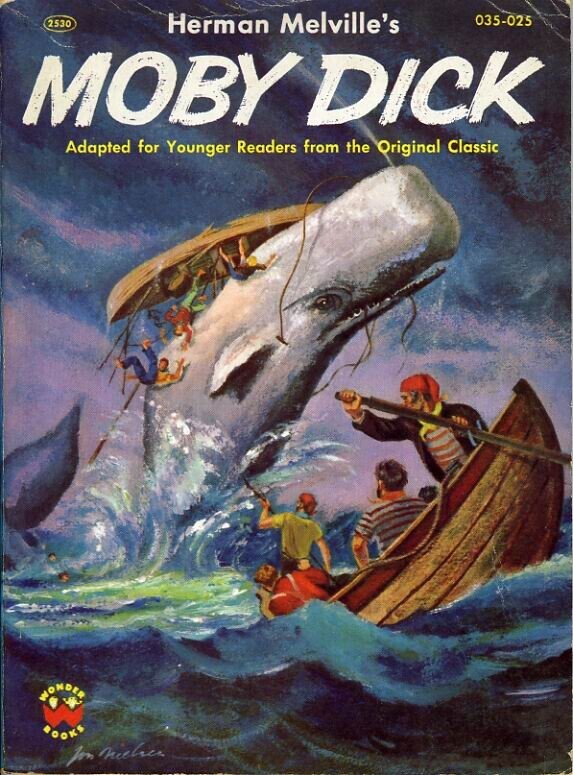
No more gam: Moby Dick is in the offing.
Cover of Moby Dick from 1969. Photo by Museon. CC-BY-4.0 via Wikimedia Commons.
Stalled in the mountains, we will progress to the ocean with our Americana. Chapter 53 of Herman Melville’s novel Moby Dick is titled “The Gam.” Those who have read the book will remember that it opens with a page bearing the title “Etymology.” Therefore, they won’t be surprised that the author supplied us with the following explanation toward the end of that chapter: “GAM. Noun—A social meeting of two (or more) whale-ships on a cruising-ground; when, after exchanging hails, they exchange visits by boats’ crews; the two captains remaining, for the time, on board of one ship, and the two chief mates on the other.” A good professional definition, even though not containing an explanation of origins.
The OED online features this odd word but cannot offer a decisive etymology. Indeed, such a monosyllabic word might come from all kinds of sources. Erich Maria Remarque even wrote a novel about a woman named Gam (certainly, not his best book). Once again, I have nothing to offer, except for an uninspiring lookalike. Russian gam (pronounced like English gum) means “great noise; ruckus.” The word is probably sound-imitative (onomatopoeic). Could English gam also once refer to a noisy gathering? To conclude, we ended up with two obscure, possibly sound-imitative, words, whose origin should have been clear, but the solution escaped us. As usual, I am turning to our readers’ expertise. Perhaps someone knows more about Hillebille and gam than I do. If so, kindly send us your comments.
Featured image: Photo by Ken Jacobsen. Public domain via Pexels.